

Your child’s teacher mentioned Math Olympiad. Another McKinney parent talked about it at school pickup. And now you’re wondering – what exactly is it, is your child ready for it, and where do you even start?
You’re in the right place.
I’m InduPriyadharsini Bharathi, founder and director of 2PI Mind Math in McKinney, Texas. I hold a Master’s degree in Engineering from Anna University and have spent over 10 years coaching math students from Grade 1 through high school. Since 2021, more than 1,200 students across McKinney, Frisco, Allen, Plano, and Prosper have trained with us. Our students have won numerous awards in Math Olympiad, Math Kangaroo, Math League, PI Math, and North South Foundation competitions.
This guide covers everything a McKinney parent needs to know about Math Olympiad – what it is, who it’s for, what it tests, and exactly how to get your child ready
Math Olympiad (MOEMS – Mathematical Olympiads for Elementary and Middle Schools) is a national problem-solving competition for students in Grades 4 through 8. It runs from November through March each year with five monthly contests. Each contest has 5 questions completed in 30 minutes. Over 120,000 students across the US and 39 countries participate annually. No prior competition experience is required.
What Is Math Olympiad?
Math Olympiad – officially called MOEMS, or Mathematical Olympiads for Elementary and Middle Schools – is one of the most respected math competitions in the United States. Founded in 1979, it now serves over 120,000 students every year across all 50 states and 39 countries worldwide.
It’s not a one-day exam. It’s a series of five monthly contests, administered from November through March. Each contest has 5 non-routine problems and a 30-minute time limit. No calculators allowed.
There are two divisions:
- Division E (Elementary): Grades 4, 5, and 6
- Division M (Middle School): Grades 6, 7, and 8
Teams can have up to 35 students. Students compete individually within their team, and both individual and team awards are given at the end of the year.
Awards are based on cumulative performance across all five contests:
- Top 50% – Award patch
- Top 10% – Plaque
- Top 3 to 10% – Silver pin
- Top 2% – Gold pin
- Perfect score – George Lenchner Medallion
For McKinney families, this means your child has five separate opportunities across an entire school year to demonstrate growth – not just one high-stakes test day.
| Is your child in Grades 4 through 8 in McKinney, Frisco, or Allen? Our math competition coaching program prepares students for Math Olympiad from the ground up. Call (469) 334-2556 |
What Math Olympiad Actually Tests
This is the part most McKinney parents don’t expect.
Math Olympiad problems are not extensions of what your child covers in school. They don’t test memorized formulas or standard procedures. They test whether your child can think through a problem they’ve never seen before – using logic, pattern recognition, and creative reasoning.
A typical Math Olympiad problem might ask a student to find a pattern in a sequence, figure out how many ways to arrange objects, or solve a multi-step word problem that requires working backwards from the answer.
The key word in MOEMS’s own description is “non-routine.” These problems are deliberately designed to have no obvious procedure. Students who succeed are those who can sit with a hard problem, stay calm, try different approaches, and find a path to the answer without giving up.
That quality – persistence with a hard problem – is something that has to be trained. It doesn’t come from doing more homework. It comes from the right kind of practice with the right coaching.
At 2PI Mind Math, our AAA Formula builds exactly this. Students Approach every problem independently first, Analyze the structure and pattern behind it, then Answer with a clear, explained solution. We teach students to think out loud – which is the single most effective way to develop the reasoning skills that Math Olympiad problems demand.
Is Your Child Ready for Math Olympiad?
Here’s the honest answer: readiness for Math Olympiad has less to do with how advanced your child’s school math is, and more to do with how they respond to unfamiliar problems.
Signs your child is a good fit:
- They ask “why” when they learn something new in math
- They enjoy puzzles, riddles, or logic games
- They don’t give up immediately when a problem feels hard
- They’re curious about numbers and patterns even outside of school
Signs they could benefit from prep before entering:
- They freeze when a problem looks different from what they’ve seen
- They rely heavily on a specific method and struggle when it doesn’t apply
- Math feels stressful rather than interesting
The good news? Both groups of students improve significantly with the right coaching. The first group develops competition-level technique. The second group builds the flexible thinking and confidence that changes how they feel about math entirely.
We see both outcomes regularly at our McKinney tutoring center – and both are genuinely worth pursuing.
How to Prepare Your Child for Math Olympiad: A Step-by-Step Plan
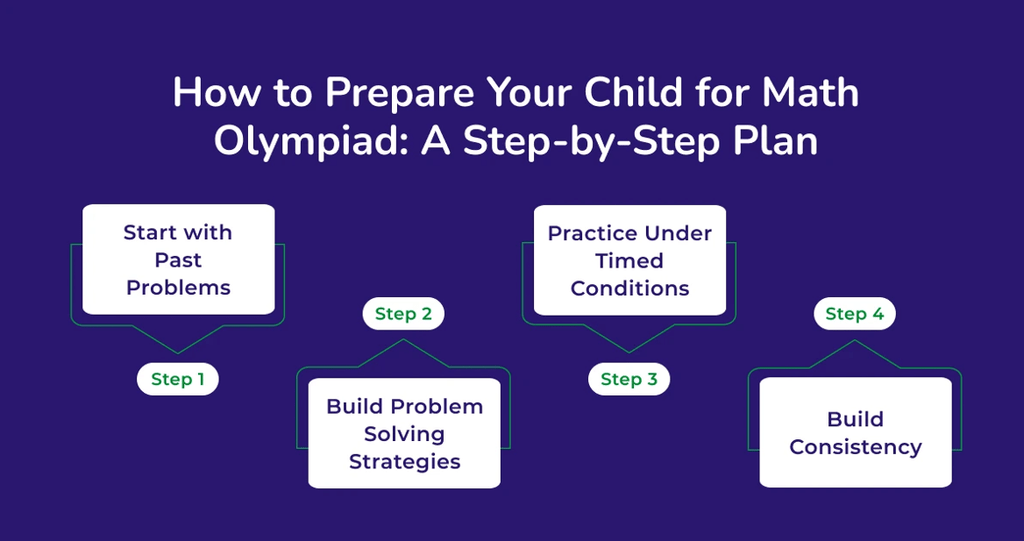
Step 1 – Start with Past Problems
MOEMS publishes official past contest problems on their website at moems.org. These are your most valuable prep resource. Start by working through 5 to 10 problems from Division E or Division M (whichever matches your child’s grade) – not to score them, but to understand what kinds of thinking the problems require.
Don’t worry if your child struggles. That’s the point. The goal at this stage is exposure, not performance.
Step 2 – Build Problem-Solving Strategies, Not Just Answers
The most common prep mistake McKinney parents make is focusing only on getting the right answer. Math Olympiad rewards the process of thinking, not just the result.
Teach your child these four core strategies that show up repeatedly in MOEMS problems:
- Work backwards – start from the answer and reverse-engineer the steps
- Draw a diagram – many spatial and counting problems become simple when visualized
- Look for patterns – sequences, number relationships, and geometry often have repeating structures
- Guess and check systematically – not random guessing, but organized testing of possibilities
At 2PI Mind Math, we embed these strategies into every competition prep session. Students practice them across different problem types until they become second nature.
Step 3 – Practice Under Timed Conditions
Each MOEMS contest gives students 30 minutes for 5 problems – that’s 6 minutes per problem. That sounds like a lot until your child sits down and realizes how much thinking each problem requires.
Starting about 6 to 8 weeks before the first November contest, run timed practice sessions at home. Use official MOEMS past papers. After the session, review every problem together – both the ones your child got right and the ones they got wrong. Ask: “How did you think about this?” not “Why did you get it wrong?”
That shift in conversation makes a significant difference in how quickly students improve.
Step 4 – Build Consistency, Not Intensity
Three focused sessions per week of 20 to 25 minutes each will produce better results than a marathon study day on the weekend. Math competition thinking develops through repetition over time – not cramming.
This is one of the things that makes our competition coaching program at 2PI Mind Math different from standard tutoring. We don’t just assign more problems. We structure practice deliberately, track which problem types each student struggles with, and build a prep plan that develops exactly the skills they’re missing.
| Ready to get your child started? We serve students in McKinney, Frisco, Allen, Plano, Prosper, Celina, Little Elm, Denton, Lewisville, and Irving – in person and online across Texas. Call (469) 334-2556 |
Why Math Olympiad Is Worth It Beyond the Score
Parents sometimes ask whether Math Olympiad is really worth the preparation time if their child isn’t aiming to win.
The honest answer is yes – and here’s why.
The skills Math Olympiad builds don’t stay in the competition room. Students who train for MOEMS develop persistence when problems are hard, confidence in their own reasoning, and the ability to think through unfamiliar situations without freezing. These are exactly the qualities that show up later in Algebra 1, Geometry, and high school math.
Parent Bharathi put it clearly: “I could see that each of Indu’s classes to my daughter were very effective and improved her in many ways. Not just math, but also in respect, leadership, and responsibility.”
That’s what competition coaching at the right level does. It builds the whole student, not just the test score.
Math Olympiad also gives students experience competing alongside peers from across North Texas and the US – which builds a sense of mathematical community and healthy motivation. Our older students at 2PI Mind Math regularly coach younger ones through quiz sessions, building both the coach’s problem-solving depth and the younger student’s confidence.
This is the leadership component of competition math that rarely gets talked about – but it’s one of the most valuable things we see in our McKinney students every year.
The Bottom Line
Math Olympiad isn’t about being the most gifted math student in the class. It’s about training your child to think through hard problems without giving up – and that’s a skill every student in Grades 4 through 8 can develop with the right coaching.
Over 120,000 students compete in MOEMS every year. McKinney and North Texas families are raising some of the most motivated young math thinkers in Texas – and the right preparation makes the difference between a child who freezes at a hard problem and one who leans in and figures it out.
That’s what we do at 2PI Mind Math, every session, for every student from Grade 1 through high school.